

Cannabis Control Commission Recognizes 10 Years of Adult-Use Cannabis in Massachusetts
A new multimedia initiative will provide data on job creation, tax revenue, equity, and more
WORCESTER—The Cannabis Control Commission (Commission) today kicked off a multimedia initiative to mark 10 years of adult-use cannabis in Massachusetts, offering insights into how the industry has become an economic force with hundreds of businesses that employ tens of thousands and has generated nearly $2 billion in state and local tax revenue.
The 10-year anniversary initiative will include a dedicated webpage featuring economic data and a video capturing the highlights of the industry over the last decade. The public will also be able to view initiative materials via the agency’s Facebook, LinkedIn, YouTube, and X pages.
“After being involved in helping to write the original cannabis regulations in 2016, it’s remarkable to return a decade later and see how much the industry has grown,” Chair Chris Harding said. “I’ve met with many licensees over the past few months—including some that are nearly a decade old—and am constantly impressed with how these businesses have become part of the fabric of their local communities. I look forward to meeting more business owners and constituents as we enter a new era for the industry, starting with reforms underway right now inside the Commission.”
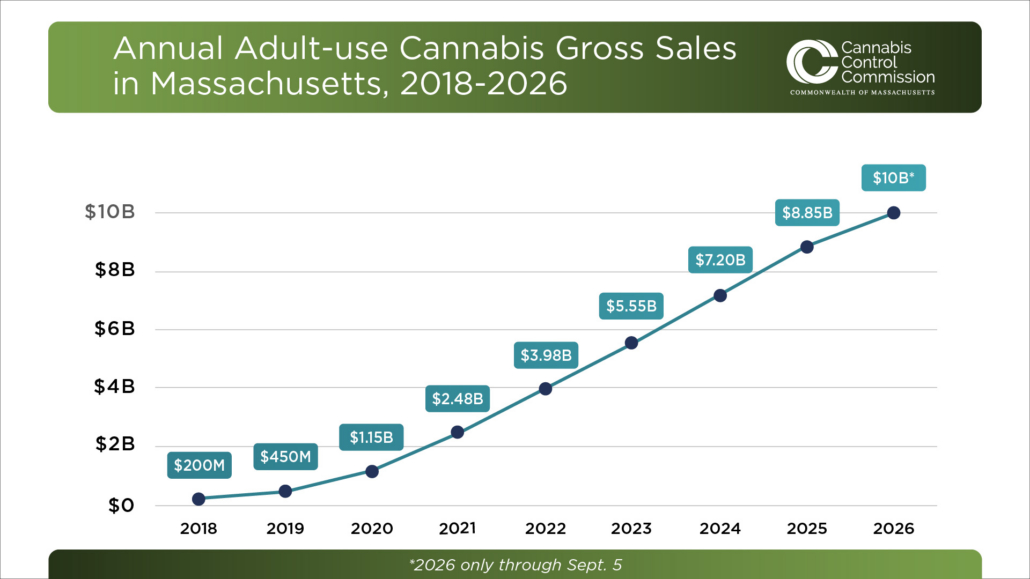
Massachusetts voters approved the creation of an adult-use cannabis industry by ballot measure in November 2016, and two years later the first two retail stores opened in Northampton and Leicester. A decade later, the industry has generated $10 billion in gross sales and now includes nearly 800 operating businesses—including many owned by participants in the Commission’s first-in-the-nation equity programs.
To move the industry forward, Commissioners in September kicked off a series of public meetings to undertake one of the largest efforts to modernize cannabis regulations in Commission history. The updates follow the passage of Ch. 65 of the Acts of 2026—a new state law that restructured the Commission and changed cannabis laws—and efforts inside the Commission to update cannabis testing rules, and to respond to constituent requests for updates to the inaugural regulations.
“After 10 years, cannabis businesses are familiar, becoming part of everyday life in hundreds of communities across the state,” Commissioner Anthony Wilson said. “As a Commissioner, I’m looking forward to shaping the next decade of the industry by working to improve and update our policies to support the growth of the industry and to protect health and safety, including the safety of workers in the industry and the safety of products available in the marketplace.”
Massachusetts was the first state to recognize the legacy of marijuana prohibition through the adult-use market. The 2016 law approved by voters directed the Commission to create policies that would encourage people from communities disproportionately harmed by prohibition to participate in the new legal market. That mandate led to the creation of the Commission’s equity programs, including the Social Equity Program (SEP).
Over 1,200 people have been accepted into the SEP over the past decade and have used it to find jobs in the industry and start businesses. As of September, 69 SEP participants had opened businesses, and over 100 others had obtained either provisional or final licensure, and many more participants are employed at adult-use businesses. The SEP is open for applications now through Nov. 30.
“Massachusetts led the nation by centering the adult-use market around equity, and we can’t forget that duty as we continue to pursue our goal of full participation by people harmed by marijuana prohibition,” said Commissioner Xiomara Albán DeLobato, whose portfolio includes equity and social justice policy at the Commission. “The SEP offers multiple ways to enter the cannabis industry, including executive and leadership training, job seeking help, or guidance toward business ownership. The SEP meets participants where they are, and we want all who are eligible and interested in this industry to use this resource.”
SEP participants are also eligible for grants from the Executive Office of Economic Development’s Cannabis Social Equity Trust Fund, which is funded by cannabis tax revenue. The fund has distributed $57.7 million in awards to over 350 operating and prospective licensees since its first funding round in 2024.
Cannabis tax revenue has grown alongside gross sales since 2018. The 10.75 percent excise tax and 6.75 percent sales tax on adult-use cannabis generated $285 million in fiscal year 2026, and $1.6 billion since 2018. Cities and towns that host Marijuana Establishments may also impose a 3 percent local sales tax on adult-use cannabis sales. The local tax has generated $287 million to date for municipalities across Massachusetts. Medical marijuana is not taxed.
The Bureau of Substance Addiction Services and public safety initiatives are some of the main recipients of cannabis tax revenue, but the revenue also flows into the state’s general fund, supporting agencies ranging from the MBTA to the Massachusetts School Building Authority.
The Massachusetts cannabis industry will continue to grow in the coming months with forthcoming social consumption licenses. New social consumption establishments will allow consumers to use cannabis in facilities regulated by the Commission. The Commission expects to begin accepting applications for the Supplemental License type in the coming months.
“It’s rare to see an industry grow from scratch like adult-use has, even rarer to see it grow so quickly in just 10 years,” Executive Director Travis Ahern said. “As we reflect on the past decade, we want to acknowledge all the hard work that our licensees and agents have put into building a marketplace that consumers can trust. As we look ahead, the Commission will continue its work of being an effective, equitable regulator, ensuring public safety while allowing the industry to innovate and evolve.”
Additional Massachusetts cannabis industry data is available by visiting the Commission’s Open Data Platform at MassCannabisControl.com, by contacting the Commission by phone (774-415-0200) or email (Commission@CCCMass.com), or following the agency on Facebook, LinkedIn, and X.
###
Legal Disclaimer:
EIN Presswire provides this news content "as is" without warranty of any kind. We do not accept any responsibility or liability for the accuracy, content, images, videos, licenses, completeness, legality, or reliability of the information contained in this article. If you have any complaints or copyright issues related to this article, kindly contact the author above.
